Getting to the real problemLeading through uncertainty

Four weeks to start over.

So we didn't. What survived the pivot became Canon Therma — a printer that calibrates itself, and the subscription that makes it work.
Role
UX Researcher &
Product Strategist
Timeline
Jan – May 2025
Pivot: final 4 weeks
Team
CMU MIIPS Capstone
6 students × Canon USA
Outcome
Product + business model
$50M SOM · $5M Y1 model
Canon Therma Printer and QuickFeed Box
The short version
What happened
Three months into a Canon project on home-based businesses, the client asked us to move to established small businesses. Under a month to deliver.
My call
The research wasn't wasted. Same people, later stage — what we knew about how they work still held. What needed re-learning was scale, stakes, and willingness to pay.
What we found
They buy a printer to stop doing things by hand — then spend their days babysitting the machine.
What we proposed
Canon Therma + QuickFeed Box: snap-fit calibration with RFID-tagged paper, plus the subscription that makes it work and makes it pay.
01

The call nobody wanted

We'd spent three months on home-based businesses — desk research, interviews, a picture of who these people were. Then Canon asked us to shift the target: established small businesses, with steady order volumes and real operations behind them.

Four weeks to research a new segment, land on a concept, build a business model, and present it to the client. The room's first reaction was that three months had just evaporated.

What I argued

I didn't think it was gone. Home-based sellers and small businesses aren't different species — they're the same people at a different stage. What we'd learned about how someone runs an operation alone, without IT support, still held. What we had to re-learn was volume, cost of failure, and willingness to pay.

But I didn't want that to be an opinion. So I proposed we go and check.

02

How I compressed three months into four weeks

Instead of running research and then design, I ran two tracks at once and used them to check each other.

Track A — 1–2 days

Re-read everything we already had

I split all prior material across the team: our own three months of research plus the data Canon had shared with us. Everyone pulled out anything that might still hold for the new segment. The point wasn't to salvage the work, it was to find out how much of the foundation was still standing.

Track B — in parallel

Go and watch real shops

I went to small businesses in person, running guerrilla interviews on what actually hurts when they print. I also mined footage owners had filmed of themselves, posting their packing routines on YouTube and Instagram to promote the shop. Nobody is performing for a researcher in those clips, and the mess around the label printer looks the same on camera as it did in the room.

Then I put the two side by side: what still matched, and what didn't.
Secondary research synthesisContextual inquiryGuerrilla interviewsDigital ethnographyWorkflow analysis
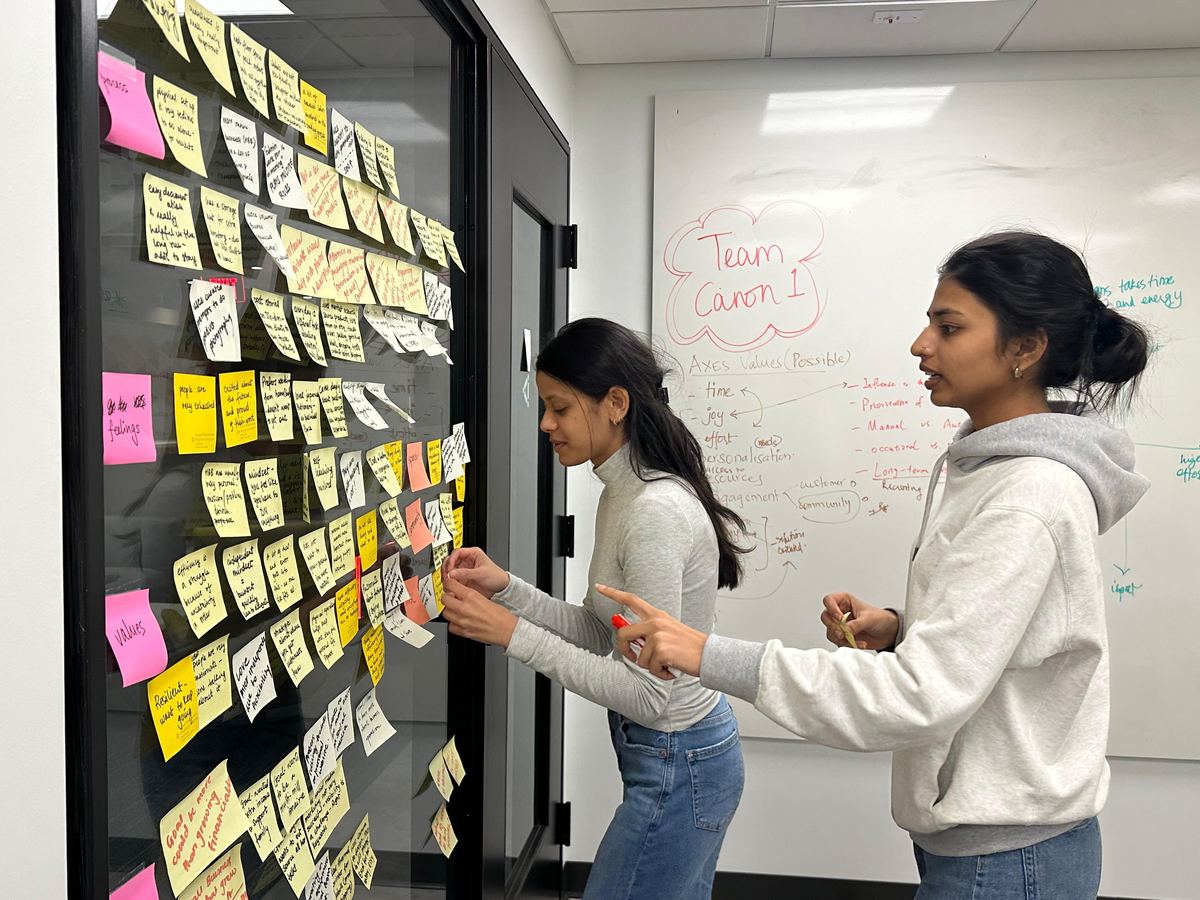
Two teammates clustering sticky notes on a glass wall beside a whiteboard headed Team Canon 1 with value axes

Fig. 1 — Re-sorting three months of prior research against what we were seeing in the shops.

That comparison is what bought us the time. Because the foundation held, we never had to rebuild it — we could research and design simultaneously instead of sequentially, and spend the four weeks going deeper rather than starting over.

03

One thing everybody said

Both tracks converged on the same answer to a basic question — why buy a printer at all?

To handle volume. To stop cutting and sticking things by hand.

That reframed the focus. I stopped asking about printers in general and pointed every remaining interview at three things: high-volume printing, efficiency, and workflow. And once we looked there, the same complaint kept surfacing — jams, and changing paper.

04

They bought automation. They got interruption.

Every jam and every roll change pulls a person back to the machine by hand — right in the middle of the batch the machine was supposed to be handling for them. And each interruption burns labels.

You buy a machine so you don't have to do it by hand.
Then you spend your day looking after the machine.

What I saw on site

One owner demonstrated a paper-size change in front of me: reload, realign, test print, adjust, test again — with a table already covered in scrapped labels.

Another had made herself a handwritten cheat sheet of every paper size, because nothing in the setup could tell her which roll was loaded.

Why this mattered

Nobody described this as a problem. They'd absorbed it — built workarounds, made peace with it. People don't write cheat sheets for things that work. You don't hear this in an interview. You have to be in the room.

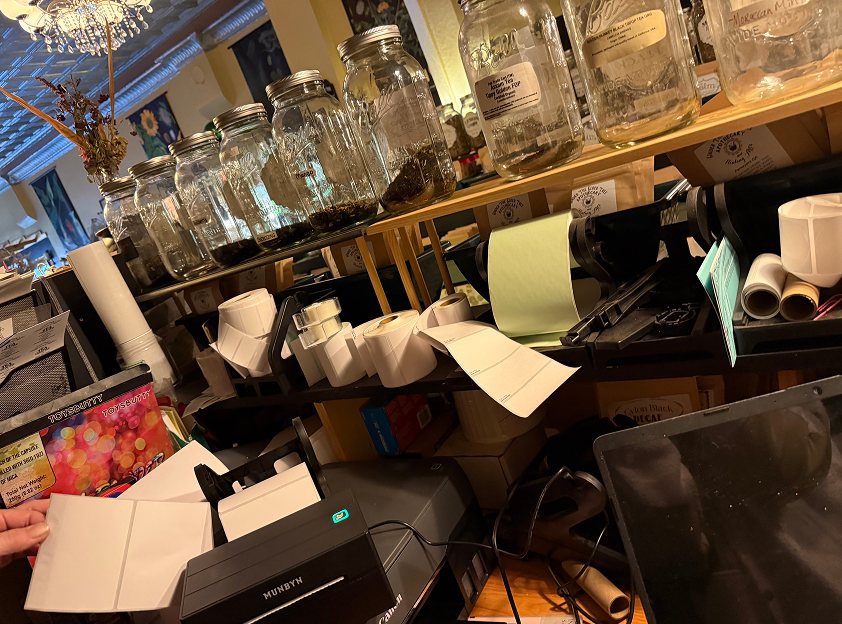
A small business workspace: label rolls in many sizes stacked on shelves around a label printer

Fig. 2 — A real setup: rolls in every size, and nothing to tell you which one is loaded.

What it was costing them

~10%of daily operations is printing
~10 minof unplanned downtime it causes every day
~390labels wasted per year (range 0–2,469)

A small task, quietly taxing the whole week. That gap — 10% of the work, a daily interruption — became the case for building something.

05

Canon Therma & QuickFeed Box

Canon's brief required hardware. So we asked a narrower question: what has to change so a roll swap stops being an event?

01

A paper box that snaps into place — and calibrates itself

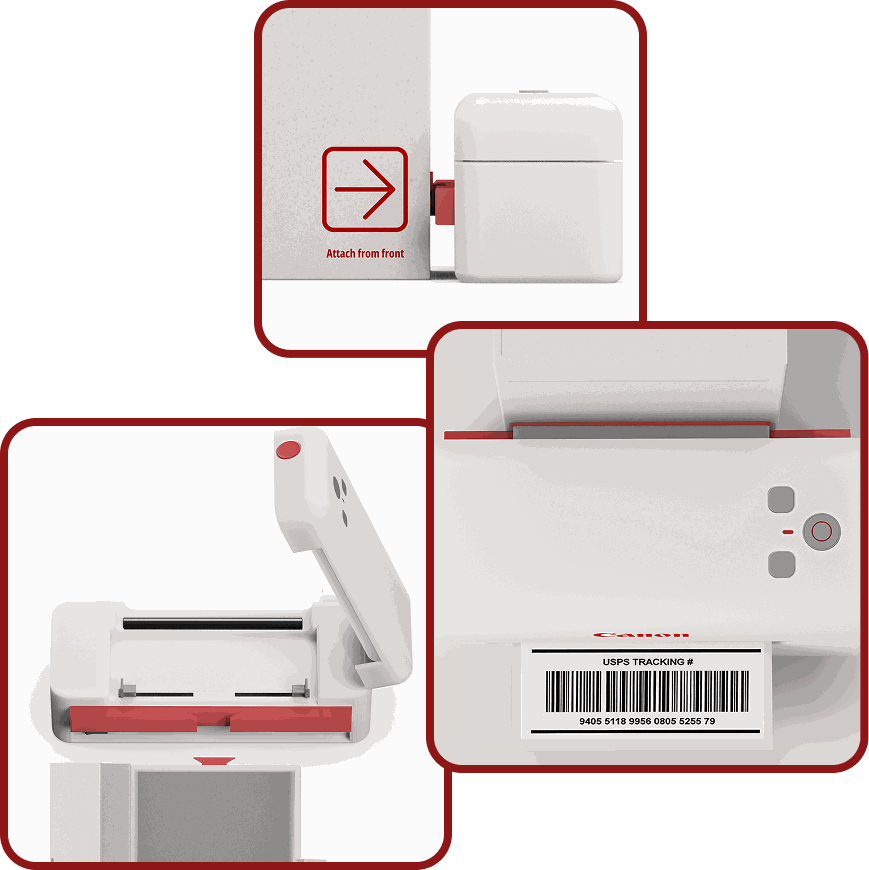
  • The QuickFeed Box clamps onto the printer's docking rails; internal guides centre any roll, from a 1" tag to a 4"×6" label
  • The moment it clicks in, Therma calibrates — no test prints, no manual guide adjustment
  • Setup goes from minutes to seconds, and mis-feeds go away
Snap-fit design: dovetail joints centre the QuickFeed Box as it clicks into the printer
02

Paper that tells the printer what it is

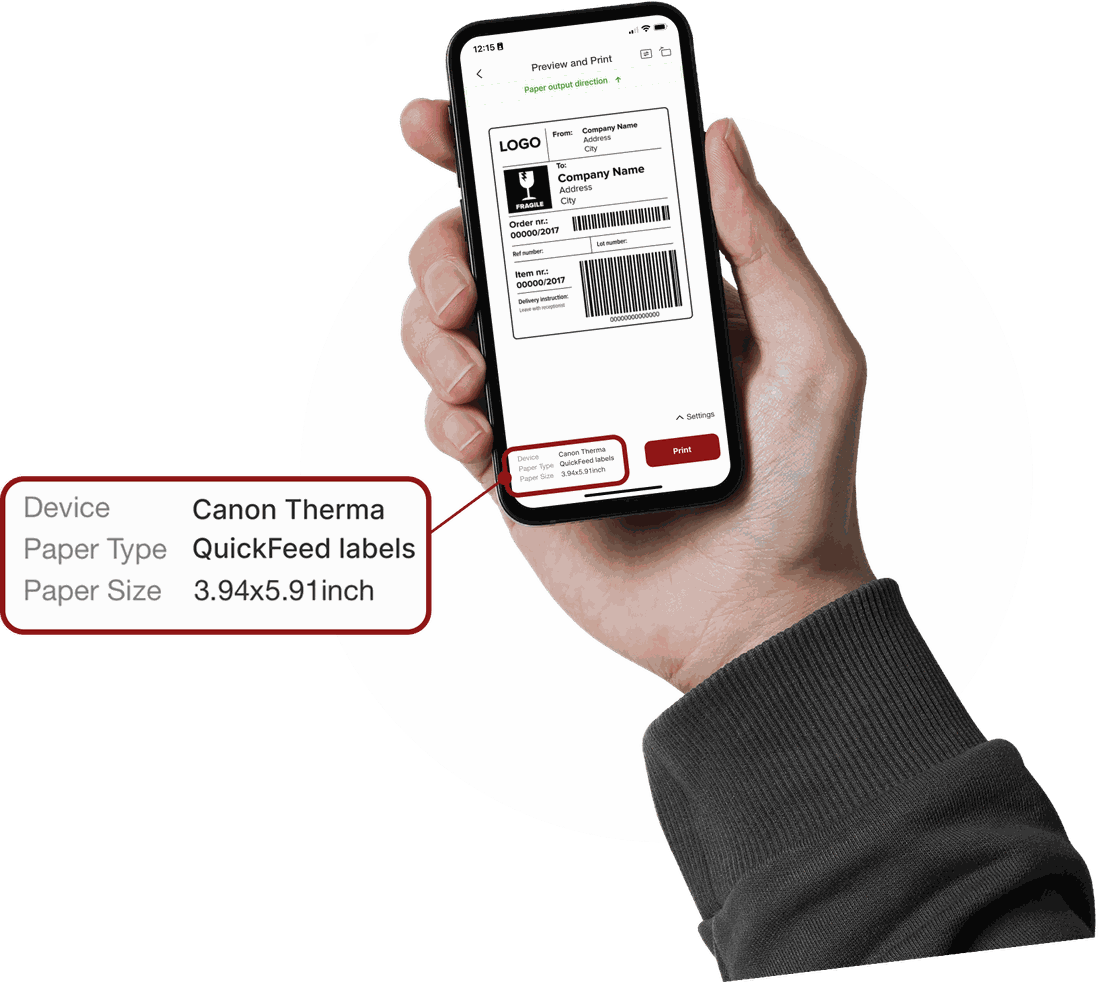
  • An RFID tag in every box reports roll type and size automatically
  • Optical edge detection maps label boundaries, streaming a true-to-size preview to the companion app
  • What you see is what prints — which kills the test-print-and-adjust loop entirely
Auto-detected paper size shown in the Canon Printer App: device, paper type and paper size
03

A workspace that stops being a pile of rolls

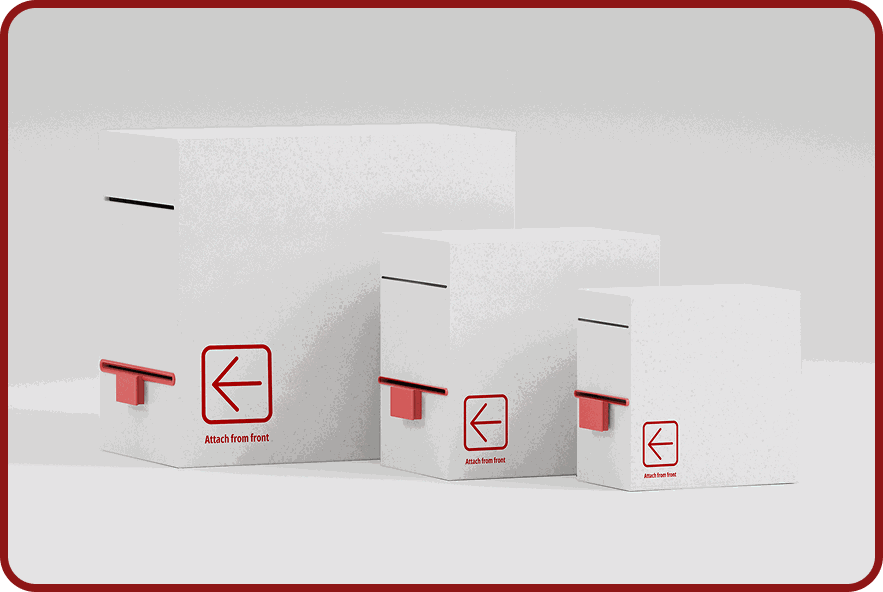
  • Boxes organise and identify sizes instead of loose rolls on a table
  • No more cheat sheet — the system knows what's loaded
QuickFeed Boxes in three sizes, stackable, keeping every paper size organised
06

The business model wasn't bolted on — it was the mechanism

Hardware was Canon's requirement. The consumables subscription was ours — and not as a way to make the numbers work. It's what makes the fix possible.

The fix

A roll change should require zero recalibration.

What that needs

The paper has to identify itself: an RFID tag in every box.

Which means

The paper has to come from Canon. A subscription is the natural form of the fix, and it eliminates the waste at the same time.

Monthly delivery in the sizes a business actually uses, sized for roughly 300 packages a month, with plan tiers as volume grows. For the user: never running out, never recalibrating, ~400 fewer wasted labels a year. For Canon: recurring revenue at 68% margin on top of one-time hardware.

The strategic point

A subscription that exists only to bill you is a tax. A subscription that exists because the product doesn't work without it is a moat — and the customer feels the benefit every time they change a roll.

07

Sizing the opportunity

We didn't stop at a concept. The team built the full commercial case so Canon could judge it as a business, not a student idea.

$50MServiceable obtainable market
$5MYear-one revenue at 10% capture
60% / 68%Gross margin — hardware / subscription

Underneath: unit costs at 20,000-unit scale, bundle pricing, three subscription tiers, fixed-cost and breakeven assumptions, and a 12–15 month rollout across design finalisation, MVP and beta.

Market sizing and the financial model were led by a teammate; I owned the research and product direction that the model was built on.

08

How I'd know if it worked

This was a proposal, not a launch. Here's what I'd instrument if it shipped — and what would tell me we were wrong.

North star
Interruptions per 100 labels
Not print quality. The promise was "you stop touching the machine" — so the metric is how often they still have to.
Drivers
  • Time from roll swap to first good print — the moment the whole design exists to collapse.
  • Test prints per job — should trend to zero; today it's the default behaviour.
  • Wasted labels per month — the ~390/year baseline is the number to beat.
  • Subscription attach & retention — if the paper is genuinely better, renewal is the honest signal.
Guardrails — how this could fail
  • Lock-in resentment. Proprietary consumables were already listed as a hidden cost users hate. If the paper premium outruns the time saved, the moat becomes the reason they leave.
  • RFID failure rate. Auto-calibration is now a single point of failure — a bad tag is worse than a manual guide.
  • Supply reliability. A subscription that arrives late is worse than buying paper locally.
09

What this one taught me

A pivot isn't a reset. When the target moved, the instinct in the room was that three months were gone. What was actually gone was one layer — the segment. The layer underneath, how these people work and why they buy, was still standing. Knowing which layer moved is what turned a crisis into four focused weeks.

Some problems have to be watched, not asked about. Nobody told us roll changes were a problem. They'd made cheat sheets instead. The insight that shaped the entire product came from standing in someone's workspace and noticing what they'd stopped complaining about.

The value of design isn't only in the insight. It's in helping a team find direction when nobody has one yet. — my takeaway from this project
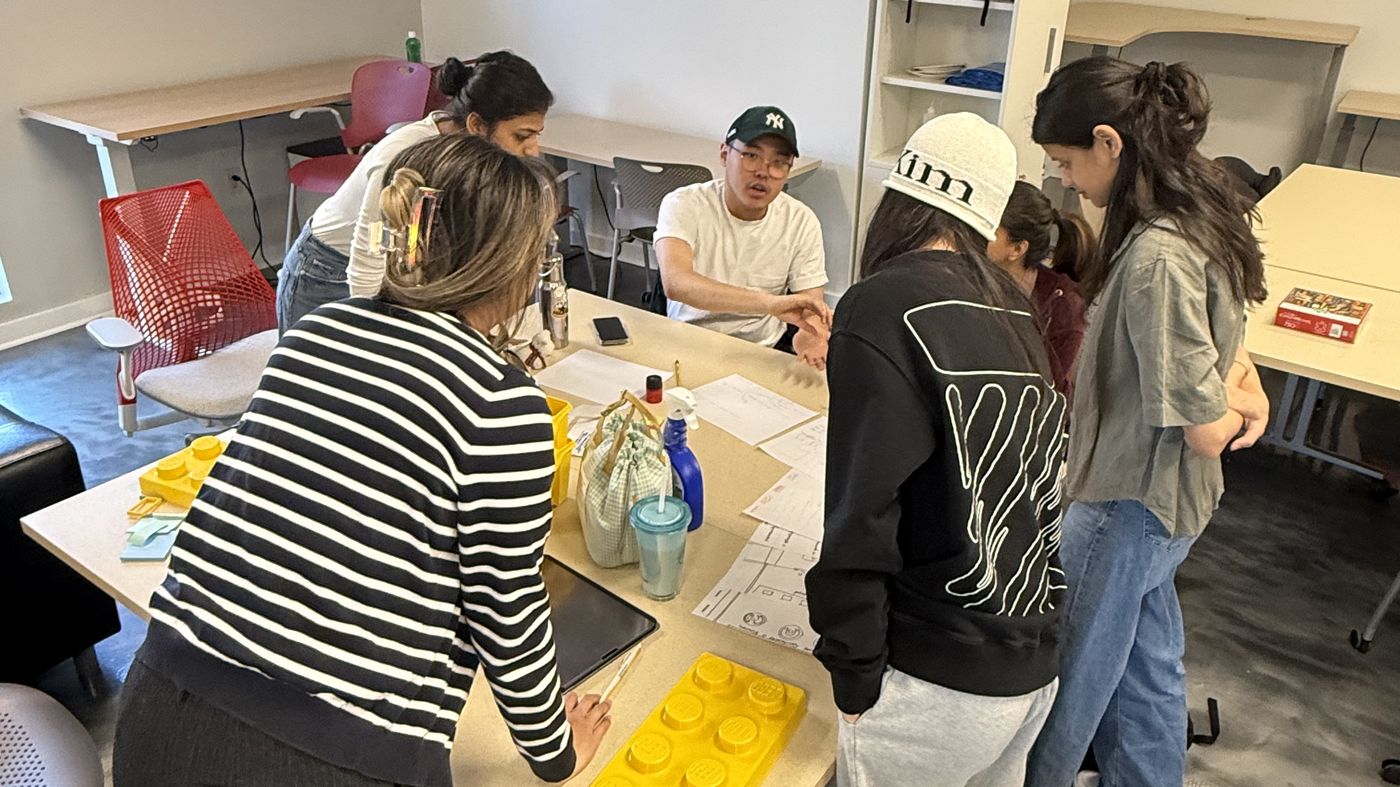
The six-person Canon capstone team working around a table