Three months after launch, growth had flatlined. What users told us contradicted what we'd shipped — and the job became finding the right direction, fast.

Perflection AI builds motion analysis for golf. We'd shipped SneakySwing on a B2B2C model — coaches on one side, their students on the other — with a promise to golfers we were proud of: a coach in your pocket. Distil a coach's expertise, build an AI digital twin, and let it analyse your swing whenever you practise.
Three months after launch, growth hadn't moved and investors were telling us the scale wasn't big enough. Inside the company, two readings were on the table: we hadn't marketed hard enough, or we'd built something people don't want.
Those two diagnoses lead to completely different companies. So I went to find out which one was true.
Coaches don't only teach — they run a business. We weren't just doing scheduling; we were integrating each student's learning profile so a coach could see who's who and how they're progressing. This part held up.
The golfer value proposition didn't survive contact with users. And no golfers using the product means coaches have nobody to push it to — the loop can't close.
We could have retreated into being a student CRM for coaches. But our differentiation is that we don't just manage lessons — we connect a student's learning state, history and individual needs. Without the golfer side, there is no differentiation and no loop. Fixing it wasn't optional.
Across interviews, the same thing kept coming back — and it went directly against the product we had shipped.
The wallet agreed with the sentiment: when AI analysis wasn't meaningfully better than the free tools already on their phone, nobody paid for it.
But they weren't saying they didn't need help. What they described wanting was specific — and it wasn't a coach substitute:
Their core need was never new knowledge — it was validation and trust. They already know what they're supposed to fix. What they can't tell, alone on a range, is whether they just did it right. Several said plainly: they'd trust the AI once their own coach had validated it.
Which meant the thing we'd built — a machine that tells you what's wrong — was answering a question nobody was stuck on.
Reading both sides of the marketplace against each other — 11 golfers and 4 coaches — gave us the overlap. Golfers want real-time feedback blessed by their real coach. Coaches want help running the business and a way into the 99% of practice they never see.
That created a hard design problem: how do you use AI heavily without letting it replace the coach? We split the work into three layers — and gave the last one away.
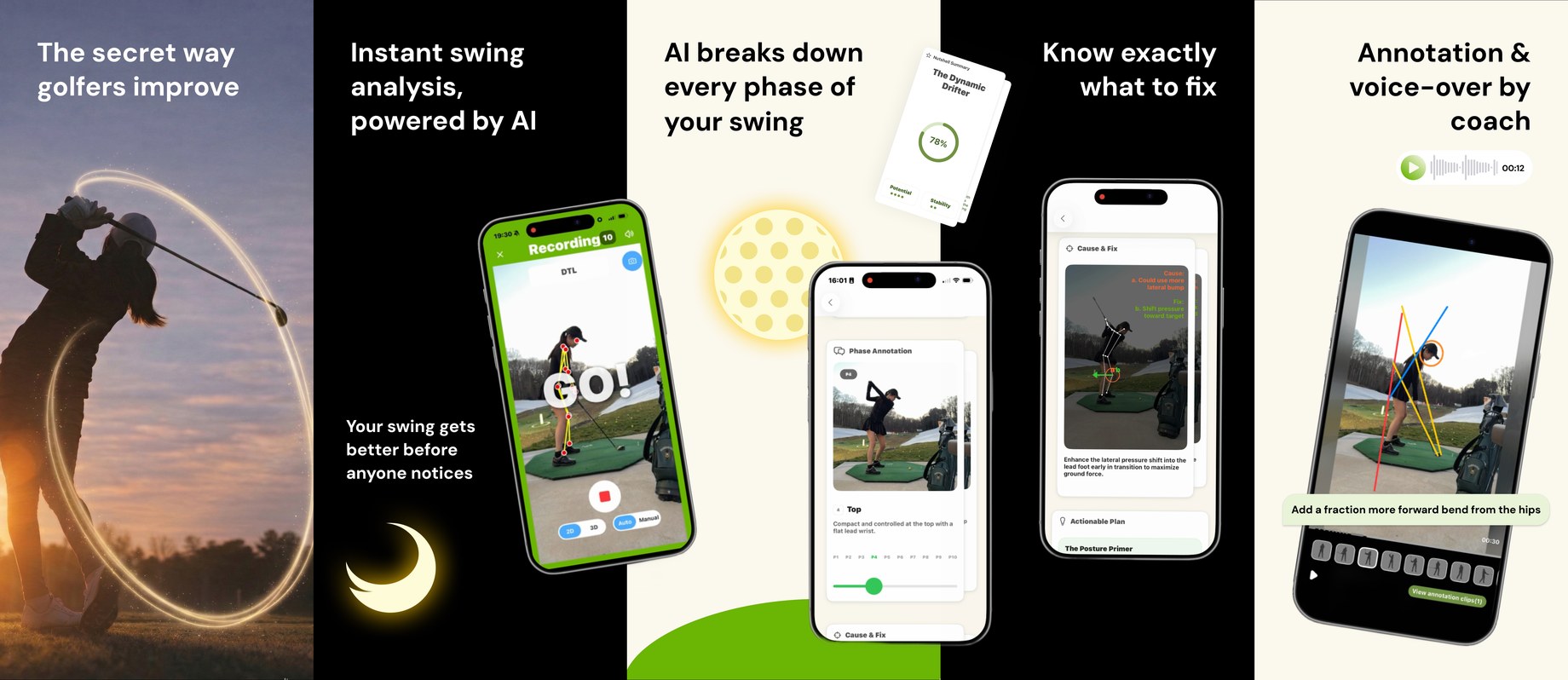
Skeleton tracking measures how much each joint drifts between swings. AI turns that into two plain sentences, one body part at a time: “your hips are steadier than last time, but the average moved.”
AI reads trends across recent sessions and offers a likely explanation — sent to the coach as an assist, never straight to the student.
The decision is never the AI's. The coach confirms or corrects; the AI absorbs that and narrows its next guess.
Every coach correction becomes an anchor, pulling the AI's possibility space from a wide circle to a tight one. The coach isn't being automated — they're being amplified, and the system gets smarter every time they weigh in.
Time is what coaches guard hardest, so we designed its allocation into the product. A dashboard shows each coach the students they actually care about — who's practising, who's improving — so their hours go to the players investing in the work, while casual students can be handled later or carried further by the AI. Attention becomes something the coach directs, rather than something the product spends on their behalf.
The research also killed the idea that there is one right report. One golfer told us skeleton points and joint-angle charts were unreadable — “I can't tell what I'm looking at.” A tour-level coach in the same study wanted the opposite: exact pelvis and chest-turn angles, side by side with a professional's swing. Same data, opposite needs. Several were also explicit that templated analysis is actively wrong for them — bodies differ, so a one-size-fits-all read misdiagnoses.
So what we're building isn't a single interface. It's a preference model × modules × components:
Three questions at signup — almost everything after that is learned rather than asked. Coaches have one too, and the system converges on both.
Plain-language cues, a dashboard, video comparison, trajectory lines, progress tracking — each a legitimate way to answer the same question.
Views get composed for a person rather than designed once for everyone, so a new preference doesn't need a new screen.
We ask for as little as possible at the door — three questions — because a long form is where new users leave. Everything after that accumulates on its own: implicit signals from what they open and act on; small questions surfaced in the drawer while their analysis is processing, turning dead time into signal instead of a spinner; the profile they choose to fill in as they get more invested; and their coach's annotations — expert labels that feed the preference model and the analysis model at the same time.
The same session then reaches three people three different ways: a body-feel cue for one golfer, a trajectory overlay for another, precise angles for their coach. Learning a sport was never a one-size-fits-all process — so the way the information arrives can't be either.
And because preference is learned rather than hard-coded, it travels with the person — which is what makes the next part possible.
Repositioning sounds clean written down. It wasn't.
Once “the coach cannot be replaced” became the premise, roughly 60% of the existing roadmap and data tagging had to be reworked. Months of model work aimed at out-performing a human coach stopped being the point — the AI no longer needed to be that powerful. The hard problem moved from model accuracy to relationship and data.
That's an expensive thing to say to a team that has been building the other thing — and it's the part of this project I'm proudest of handling. I came in as a UX researcher; I now set product direction and lead a 6-person product team across design, growth and research. The work that actually takes the time isn't the research. It's holding a direction steady across people who each see a different part of it: engineers who'd built for the old premise, designers who need decisions to be concrete, founders carrying investor pressure, and 11+ partnered PGA coaches whose trust is the product.
The reposition only stuck because each of those groups could see their own reason to believe it. Not being the person with the answer — getting everyone pointed at the same one.
We ship every one to two weeks. Research that takes six weeks to answer a question is research nobody will wait for — so the real constraint on my work isn't rigour, it's keeping pace with the build.
That pace is our biggest advantage over a large company: we can be wrong far faster than they can be right. But being wrong is only cheap if you can tell that you were — quickly, and ideally before it costs a release. Two things make that possible.
At our scale, no number is significant on its own. That doesn't mean we don't look — we read everything; we just never let a number conclude anything by itself. Small samples don't lie, they under-determine. The risk isn't missing the signal, it's over-reading it. So nothing travels from a chart to a decision without passing through people on the way.
Flat growth. Low report adoption. A number tells you where to look — never why.
Interviews surface the reason nobody wants a substitute coach. This is where the hypothesis is born.
The reposition ships. AI-report adoption moves 32% → 56% within two months, and has held at 53–59% since. Now the story has a number on it.
One golfer told us feedback within 2–3 seconds is useful; 10 seconds is worthless — “by then I've already hit the next ball.” A sentence in an interview became a hard acceptance threshold the engineering team now builds against. Qualitative work doesn't only explain things; it produces the numbers worth tracking.
Willingness-to-pay surveys give you a band. Interviews tell you what people are pricing you against. One golfer capped us at $100/month, anchored on his ChatGPT and Claude subscriptions plus lesson fees. Another would pay $10–20. On a chart both read as “price sensitive.” In reality they're two different products.
For a 0→1 product, most of what needs testing hasn't been built. So I built a scorecard for usability and concept sessions that scores whether a user actually understands the new concept and whether they'd accept it — turning a qualitative session into a number we can track across versions. “Does the new direction land?” stops being an opinion in a meeting.
A public release is an expensive way to find out a concept doesn't land — and at a two-week cadence, that's an expensive mistake you could repeat twenty-six times a year. Trial and error only works when the error is caught somewhere cheaper. So I built the research to run on two tracks at once.
Benchmarked usability on live versions, scored against the same card release over release — so we can tell whether each version actually got easier, not just different.
Concept exploration with the designers — pressure-testing directions with users before engineering commits, and deciding together what's feasible and worth building.
This is dual-track research: discovery and delivery running in parallel rather than in sequence. The delivery track keeps the current product honest; the discovery track keeps us from betting a roadmap on a hunch. The moment the two become sequential, you're either polishing something nobody wants or shipping something you never checked — and at our speed, either one compounds fast.
What holds both halves together is a persona system built on behaviour, not attributes — level of investment × willingness to pay × core need — with sample size and confidence attached to every segment, so we always know how much weight a finding can bear. An n=1 segment stays provisional. Nobody gets force-fit into a category to make the deck look tidy.
In a company where the product changes month to month, personas built on attributes rot on contact with a pivot. Built on behaviour, they survive one — and the team is still using them.
The investor feedback was always the same sentence: the scale isn't big enough. Golf coaching is a small market. They were right about the market — and wrong about what we were building.
The answer came out of the same asset thinking that fixed the product. A coach can treat a student's learning history as an asset: who practises, who improves, who deserves their scarce time. My extension was the other half — the student owns one too. They should be able to export their learning and progress state (not the coach's instruction, which stays with the coach) and carry it with them.
Once a record of how a person moves and learns is portable, the market stops being golf:
A golfer changes coaches without starting from zero. The new coach opens a history instead of an empty file.
Golf, ski, tennis. A yoga or surf instructor instantly understands how this person controls their body — and where they'll struggle.
A physio can see what caused an injury. A coach can adapt around a spinal condition they'd otherwise never know about. The training record becomes clinical context.
Movement and learning data across people, sports and recovery — the layer underneath all of it.
It isn't a bigger number bolted onto the deck. The scale story and the product story became the same story — both come from treating the learning record as something the user owns and carries. That's the version investors leaned into, and it's the direction I've been steering the roadmap toward since: where sports science meets digital health.
Flat growth is a question, not a verdict. “Market harder” and “we built the wrong thing” look identical on a dashboard. The only way to tell them apart is to go and ask — and to be willing to hear the second answer.
Speed is only a virtue with a direction attached. A two-week cadence means you can be wrong twenty-six times a year, or right twenty-six times — the velocity is identical. What separates them is whether anyone checked. Moving fast is what got us to the wrong product quickly; moving fast and checking is what got us out of it.
The best product decision I made was to make our AI less ambitious. Once the evidence said the coach can't be replaced, the model didn't need to win. Sometimes the strategic move is to give the hardest part of the job away — to the human the user already trusts.
Users don't reject AI. They reject being handed a worse version of something they value. That's the sentence I'll carry into whatever I build next.